What is xRAM?

xRAM is Ramses' non-transferable voting token. It lets holders direct weekly RAM emissions and receive eligible voter fees and incentives without a fixed-duration lock.
xRAM conversion, staking, voting, and r33 minting and redemption currently run on HyperEVM. r33 can move across its supported OFT routes and is called hyperRAM on HyperEVM and r33 on other chains.
Participate without a fixed-duration lock.

What can I do with xRAM?
xRAM holders can stake and vote to direct emissions to eligible pools. Under the default gauged-pool configuration, voters receive 100% of the swap fees from pools they vote for, plus eligible vote incentives; gauge-specific fee splits can differ.
On HyperEVM, holders can instead deposit xRAM into an AutoVault and choose from output tokens currently enabled in the app, or mint r33 (hyperRAM on HyperEVM) to automate voting and compound eligible rewards.
Vote to direct emissions and earn the configured voter share of swap fees plus eligible vote incentives.
Stake xRAM in an AutoVault and choose from the output tokens currently enabled in the app.
Mint r33 (hyperRAM on HyperEVM), the liquid-staked xRAM that compounds eligible fees and vote incentives.
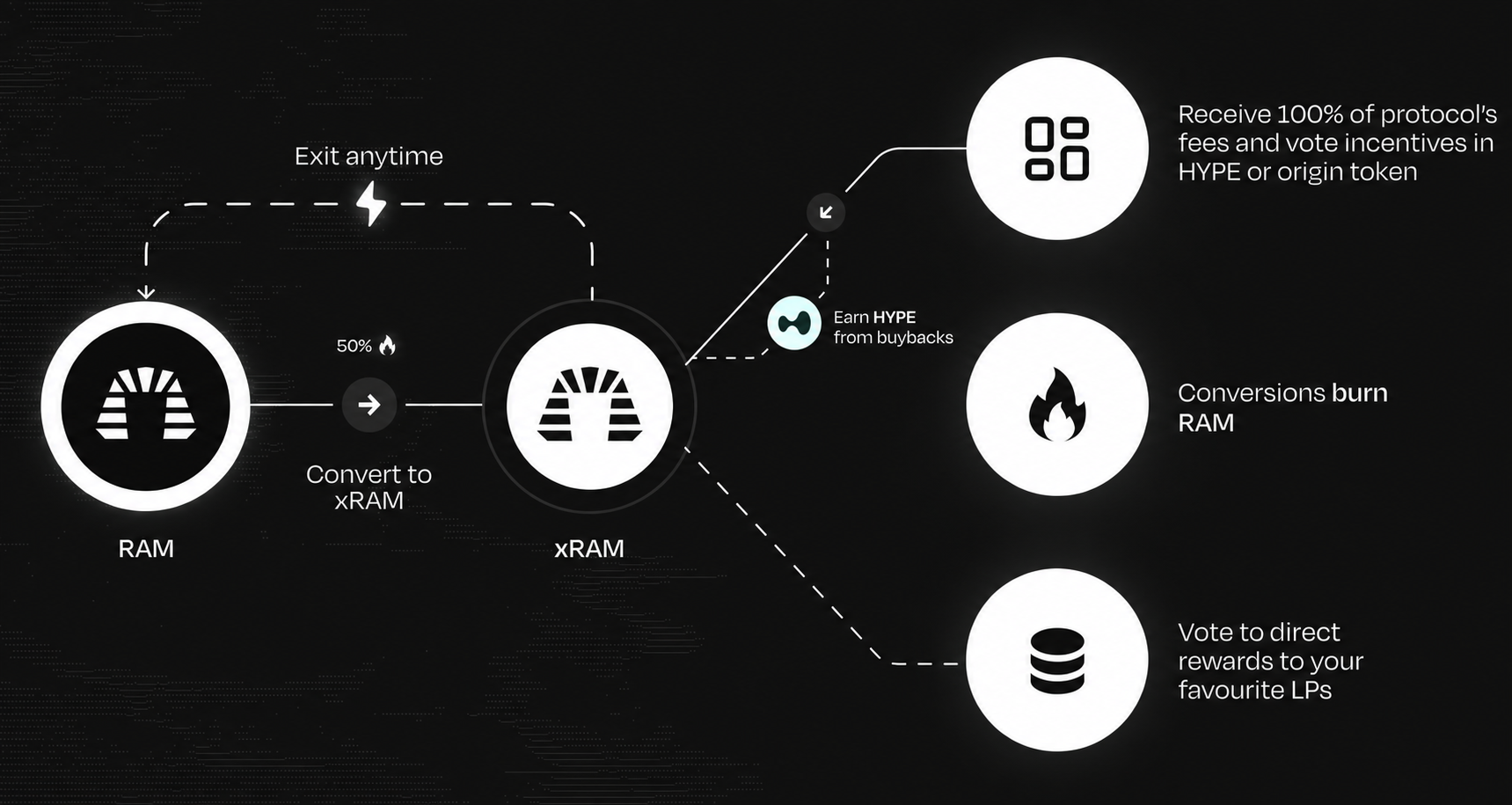
Token
xRAM is minted 1:1 from RAM input and cannot be transferred between wallets. For every RAM amount converted, 50% is burned and the remaining 50% stays in the xRAM contract to fund direct redemption at 0.5 RAM per xRAM. Staked xRAM provides Ramses voting power.
How is xRAM obtained?
Users mint xRAM by converting RAM. xRAM may also be received through an incentive or distribution that explicitly offers xRAM; weekly gauge emissions are paid in RAM.
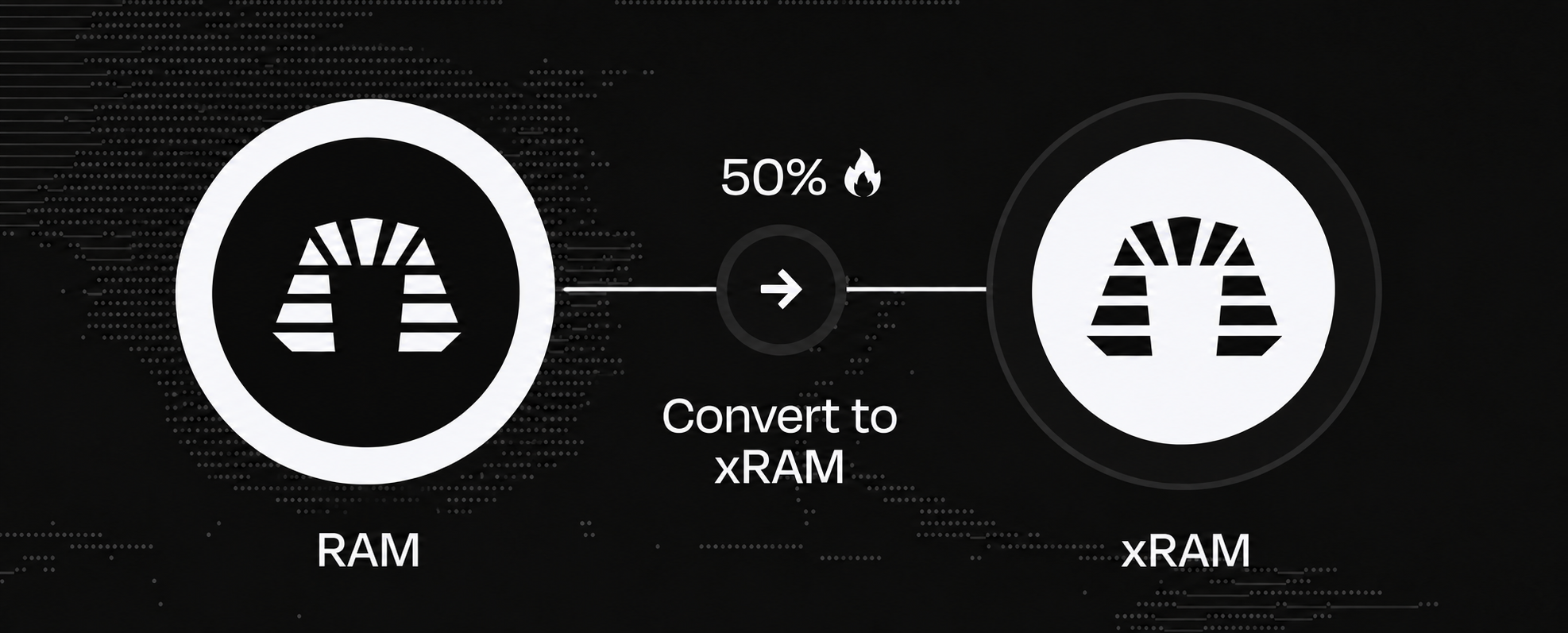
RAM → xRAM Conversion
RAM can be converted into xRAM at any time. The full RAM input amount is minted as xRAM, 50% of that RAM input is burned, and the remaining 50% backs direct redemption.
How to exit xRAM?
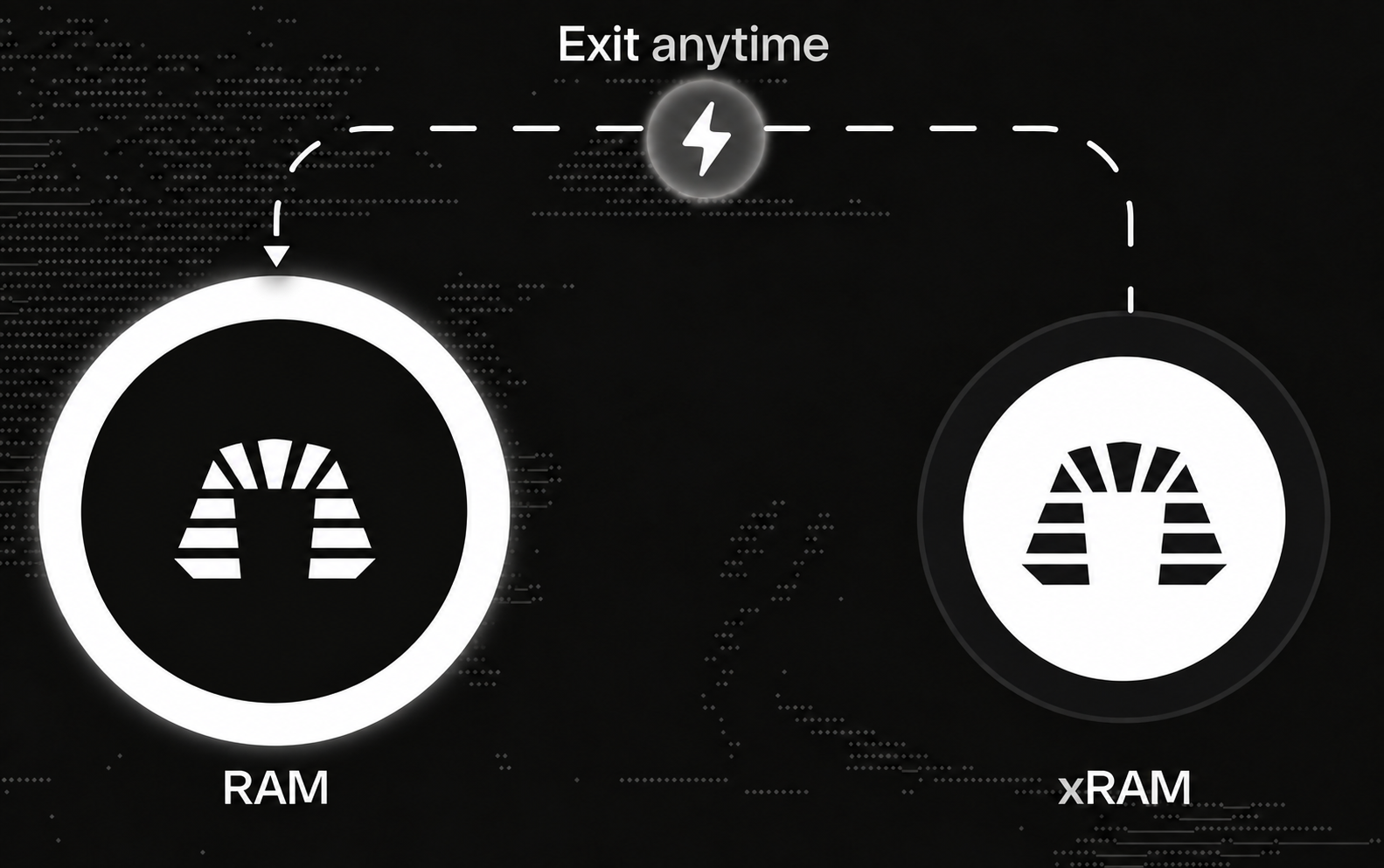
xRAM → RAM Redemption
Users can exit an xRAM position in two ways:
- Direct redemption — Redeem xRAM for RAM at 0.5 RAM per xRAM.
- Liquid-staking market exit — Hold r33 and trade it on an available market, subject to market liquidity, price impact, cooldowns, execution costs, and protocol risk.
AutoVaults

AutoVault is currently available on HyperEVM. Users deposit xRAM, choose from output tokens currently enabled by the vault contract, and let the vault operator submit votes each epoch.
After an epoch flips, the operator collects allocated fees and vote incentives, converts them into each user's selected output token, and credits claimable rewards. Rewards are not sent automatically; users claim them when the vault is unlocked.
| Source | Conversion | Distribution |
|---|---|---|
| Eligible fees and vote incentives | Converted into the selected output token after epoch flip | Credited pro rata for manual claiming |
Unstaked xRAM does not earn AutoVault rewards. The output-token selector in the app is the current source for enabled reward choices.
xRAM Liquid Staking
r33 is the liquid staked version of xRAM. It is known as hyperRAM on HyperEVM and r33 on other chains; both names refer to the same product. These docs use r33 as the general name and retain hyperRAM where it identifies the HyperEVM token, contract, or integration.

r33 automates voting and compounds eligible fees and vote incentives into additional xRAM backing. Users hold a transferable token instead of managing weekly votes directly.
r33 (hyperRAM)

r33 can be minted with xRAM. Its xRAM redemption ratio starts at 1.00:1.00 and is designed to increase as eligible rewards are converted into additional backing.
| Feature | Details |
|---|---|
| Automated voting | The strategy submits votes each epoch |
| Reward conversion | Collected fees and incentives are converted through supported routes into additional backing |
| Auto-compounding | Additional backing increases the amount of xRAM redeemable per r33 |
| No protocol fees | No protocol fee for deposits, redemptions, or compounding; network gas still applies |
| Transferable token | r33 can trade on available markets, subject to liquidity and execution conditions |
| On-chain redemption ratio | The current ratio is read from the liquid-staking contract |
After each weekly epoch flip, collected fees and vote incentives are converted into additional backing. The example below is illustrative; the actual r33:xRAM ratio changes with realized rewards.
Market price and redemption value
r33 can trade on available markets, but it does not change xRAM's direct-redemption economics. RAM → xRAM conversions burn 50% of the RAM input, and each xRAM redeems for 0.5 RAM. The r33 market price can differ from its redemption value because of liquidity, price impact, cooldowns, execution costs, and protocol risk.
Conversion Burn
Each RAM → xRAM conversion burns 50% of the RAM input and retains the other 50% as direct-redemption backing. This reduces circulating RAM when conversions occur. It does not distribute the burned RAM to users or guarantee a market-price outcome.
Voting
Manual xRAM voting currently runs on HyperEVM. Staked xRAM holders allocate weekly RAM emissions among active gauges.
Under the default gauged-pool configuration, voters receive 100% of the swap fees from pools they vote for plus eligible vote incentives. A gauge can use a different fee split, so its current configuration controls. Ungauged pools use the default 95% liquidity-provider and 5% protocol split.
| Swap Fees | Vote Incentives |
|---|---|
| The pool's configured voter share, allocated in proportion to votes | Eligible incentives offered to attract votes to the gauge |
Voting Breakdown
Votes determine each active gauge's share of next-epoch RAM emissions. Emissions are then distributed under that gauge's reward rules.
Emission Calculation
Expected pool emissions are calculated from total epoch emissions and the pool's share of all eligible votes:
- Pool emissions = total epoch emissions × (pool votes / total eligible votes)
For example, if an epoch distributes 100,000 RAM and a gauge receives 10% of eligible votes, that gauge receives 10,000 RAM for the epoch. The rewards stream over the epoch according to the gauge's qualifying-liquidity rules.
Vote Weight Calculation
Voting power is based on the user's staked xRAM balance in the VoteModule. Users allocate that power proportionally across selected pools:
Pool vote weight = xRAM voting balance × (submitted pool weight / sum of submitted weights)